You are about to spend real money on equipment that has one job: to be in the right place if the worst day of your life arrives. The fear is reasonable.
Buy the wrong size and you end up with armor that either leaves a gap over the organs it was supposed to protect, or that you cannot move, sit, or shoot in. Both should be considered failure points.
Here is the good news: sizing a plate carrier is simpler than the internet makes it look, as long as you start from the right rule.
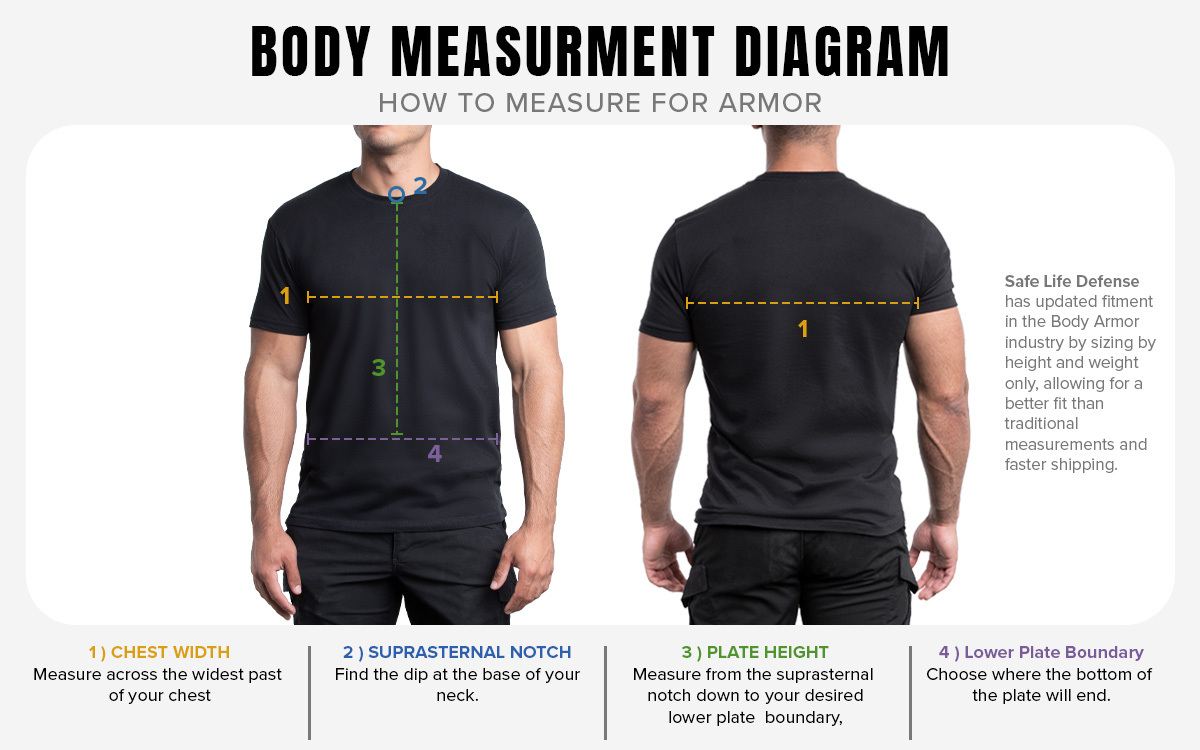
Plate carrier size is based on the size of the armor plate it holds, not your shirt size. To size yourself, measure your chest width from nipple to nipple, measure your torso height from the suprasternal notch (the dip at the base of your throat) down to about two inches above your navel, then choose the plate that covers that area and the carrier built to hold that plate. Get this right and the plate protects your heart and lungs without wrecking your mobility.
If you are not yet sure what a plate carrier actually is or how it differs from soft armor, start with our breakdown of what a plate carrier is, then come back here to get sized.
The Rule That Prevents the Most Common Mistake
The single most common sizing mistake is buying a plate carrier the way you buy a t-shirt. Someone wears a large shirt, so they order a large carrier. It feels logical, and it is wrong often enough to be dangerous.
A plate carrier is a holder. The plates inside it are the protection. So you size the plate to your vital area first, then pick the carrier built to hold that plate.
The “size” printed on a carrier refers to the plate it accepts, not the body it goes on. In practice, most people end up in a carrier one size smaller than their shirt.
It is worth killing the “bigger means more protection” myth right now, because it gets people hurt.
Your ribcage, and the organs behind it, do not grow when you size up your shirt. A larger plate does not cover new vital anatomy.
It just adds weight and width, which on the move means the carrier shifts off your centerline, bounces, sags, and digs into your lap when you sit. An oversized setup is less protective in the ways that matter, not more.
The other direction is just as real. A carrier and plate that are too small leave a gap over the very organs they are meant to cover, and a plate that small often cannot be adjusted high enough to do its job.
Too big fails you on the move. Too small fails you standing still. The target is the plate that covers your vitals and a carrier that holds it there. SLD plate carriers are sized to standard plate footprints for exactly this reason.
To size the plate correctly, you have to know what it is protecting. This is where most guides wave their hands and say “cover your vital organs.” Here is what that actually means.
Why Sizing Is a Safety Decision, Not a Comfort Decision
Body armor is a compromise. A full suit of plates would be safe and useless, because you could not move or fight in it.
So armor is engineered to cover the highest-value real estate on your torso and accept that it cannot cover everything. Knowing where that real estate sits is the whole reason ride height and plate size matter.
The priority zone is your cardiac box: the rough rectangle over the center of your chest, bounded by your collarbones at the top and your lower ribs at the bottom, that contains your heart and lungs.
Behind the upper part of your sternum sits the mediastinum, the central compartment of the chest that holds the heart and the great vessels: the aorta and the superior and inferior vena cava. These structures sit high and central. A wound to them is rapidly fatal even with a trauma surgeon standing over you.
That is the entire reason a plate has to ride high. A plate worn two inches too low slides its protection off the heart and great vessels and onto your stomach.
Your stomach is not the priority. When you read that a plate “covers your vital organs,” this is the specific anatomy in question, and it is why a sloppy fit is not a comfort problem but a coverage problem. The right plate size and the right ride height exist to keep this exact area covered while you move.
Sizing and threat level are two separate decisions, and it helps to keep them separate in your head. This guide gets you the right size and fit. Choosing how much protection that plate or panel actually provides is a different question, covered in our guides to NIJ protection levels and soft armor versus hard armor.
Decide your size here; decide your threat level there.
Now you know what the plate has to cover. Here is how to measure yourself so it does.
How to Measure Yourself
You need a flexible tape measure and, ideally, a second set of hands or a mirror. Measure over the clothing or armor you will actually wear the carrier with, not bare-chested if you plan to run it over a uniform or soft armor.
A quick note for soft armor. If you are sizing soft, concealable armor or wrap-around panels rather than hard plates, the measuring logic changes, because soft armor is sized to your body rather than to a plate.
For those, SLD offers a free Find My Size tool that works from your height and weight. We explain why the two systems differ near the end of this guide.
With your width and height in hand, match them to a standard plate size. This is where the SAPI and commercial systems collide, so here is the one chart that settles it.
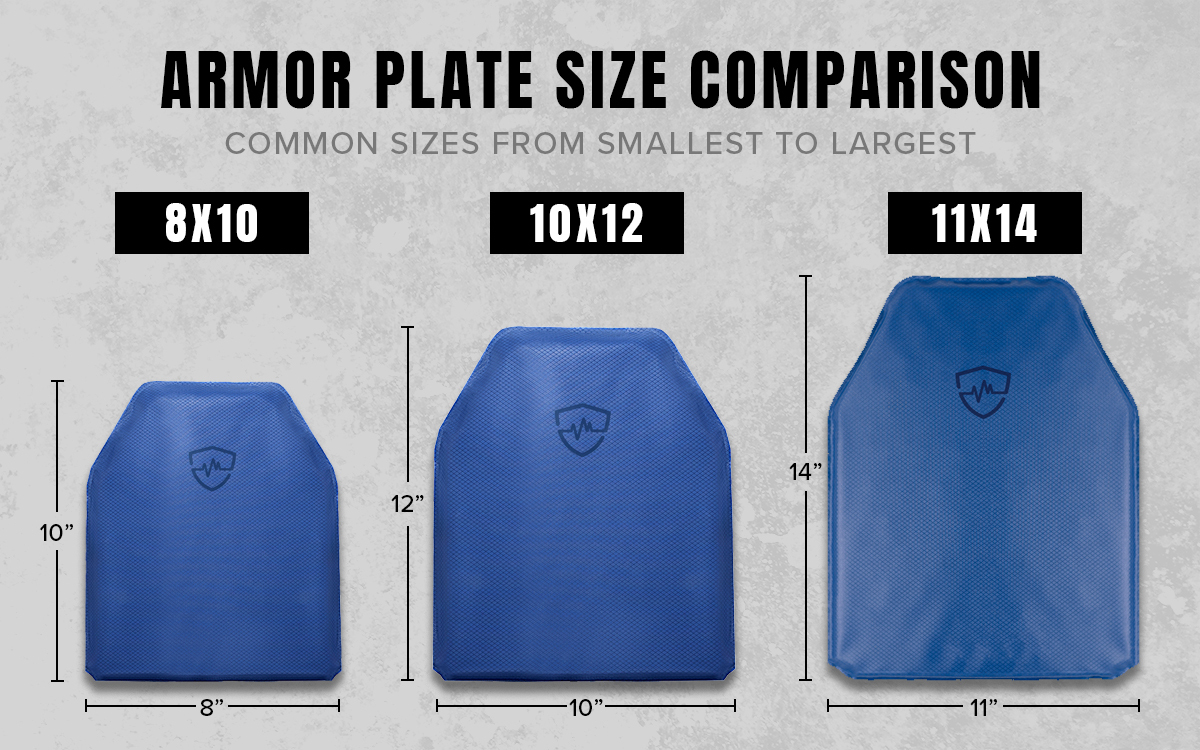
Plate Size Reference: SAPI vs Commercial
There are two sizing systems on the market, and confusing them is how people end up with a plate that will not seat correctly in their carrier.
The first is the military SAPI system (Small Arms Protective Insert), which runs from Extra Small to Extra Large.
The second is the commercial system, which clusters around three nominal sizes: 8×10, 10×12, and 11×14 inches. They overlap, but they are not the same, and the differences are large enough to matter.
| Size | System | Approx. dimensions (W x H) | Best starting point for |
| XS SAPI | Military | ~7.25 x 11.5 in | Very small frames; rare |
| Small SAPI | Military | ~8.75 x 11.75 in | Smaller and shorter builds |
| Medium SAPI | Military | ~9.5 x 12.5 in | The most common military size |
| Large SAPI | Military | ~10.125 to 10.5 x 13.25 in | Taller builds, more vertical coverage |
| XL SAPI | Military | ~11 x 14 in | Tall or large-framed wearers |
| 8×10 | Commercial | 8 x 10 in | Shorter stature, smaller torsos |
| 10×12 | Commercial | 10 x 12 in | The civilian default; fits a large share of adults |
| 11×14 | Commercial | 11 x 14 in | Larger and taller builds |
A few things this chart makes clear. A Medium SAPI is about 9.5 by 12.5 inches, which is not the same as a commercial 10 by 12. That half inch in each direction is enough to change whether a plate seats correctly in a carrier pocket built for the other standard.
It gets murkier still: “10×12” plates vary by as much as plus or minus an inch between manufacturers, so the number on the label is not a guarantee of the actual footprint.
Always treat the printed size as a label, not a measurement. (Exact SAPI figures vary slightly between sources; the Large width in particular is reported as both roughly 10.125 and 10.5 inches, so treat these as the standard footprints rather than to-the-millimeter specs.)
As a practical shortcut, stature maps loosely to size: under about 5 feet 2 inches leans toward 8×10 or Small SAPI; roughly 5 feet 3 inches to 6 feet leans toward 10×12 or Medium SAPI; 6 feet to 6 feet 4 inches without a broad chest often benefits from a Large SAPI for the extra vertical coverage; and 6 feet 4 inches and up leans toward 11×14 or XL.
These are starting points, not rules. Your measurement beats your height every time. There is a reason a 10×12 is the civilian default: it covers the cardiac box for a large share of adults, which is also why so much off-the-shelf armor is built around it.
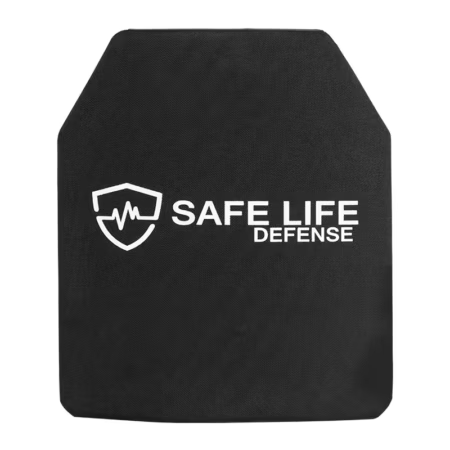
SLD hard plates and flexible rifle armor are offered in the standard footprints, and the Unity Hybrid carrier accepts 8×10, 10×12, 11×14, and SAPI sizes, so you are not locked out of a size by the platform.
Once you know your plate size, choosing the carrier looks simple. There is one cross-brand trap that catches people, so read this before you add a carrier to your cart.
From Plate Size to Carrier Size
The convention is straightforward: a Medium carrier holds a Medium or 10×12 plate, a Large carrier holds a Large plate, and so on. The carrier “size” describes the plate bag, not your body.
Here is the trap. That convention is not a standard, and a “Medium” carrier does not mean the same plate at every brand.
One maker’s Medium pocket fits a 10×12 cleanly; another maker fits that same 10×12 best in a Large. If your plates and your carrier come from different companies, the labels alone will eventually burn you.
The reliable move is simple: read the carrier’s stated plate compatibility before you buy. Most product pages list exactly which plate footprints the pocket accepts.
If you already own plates, match the pocket to those specific plates. If you are buying both, lock in your plate size first, then pick the carrier built for it.
Adjustable shoulder straps and cummerbunds tune the carrier to your body, and they cover a wide range of builds, which is why a single common size built for a 10×12 fits so many people once it is dialed in.
But understand what adjustment does and does not do: it changes how the carrier sits on you, not which plate fits the pocket. The pocket size is fixed by the bag.
This cross-brand guesswork disappears when the plate and the carrier come from the same system. SLD carriers are sized to standard plate footprints, and the Unity Hybrid system accepts soft panels and 8×10, 10×12, 11×14, and SAPI plates, so the pocket and the plate are designed to agree.
You have the right plate and the right carrier. Now prove it fits before you ever rely on it.
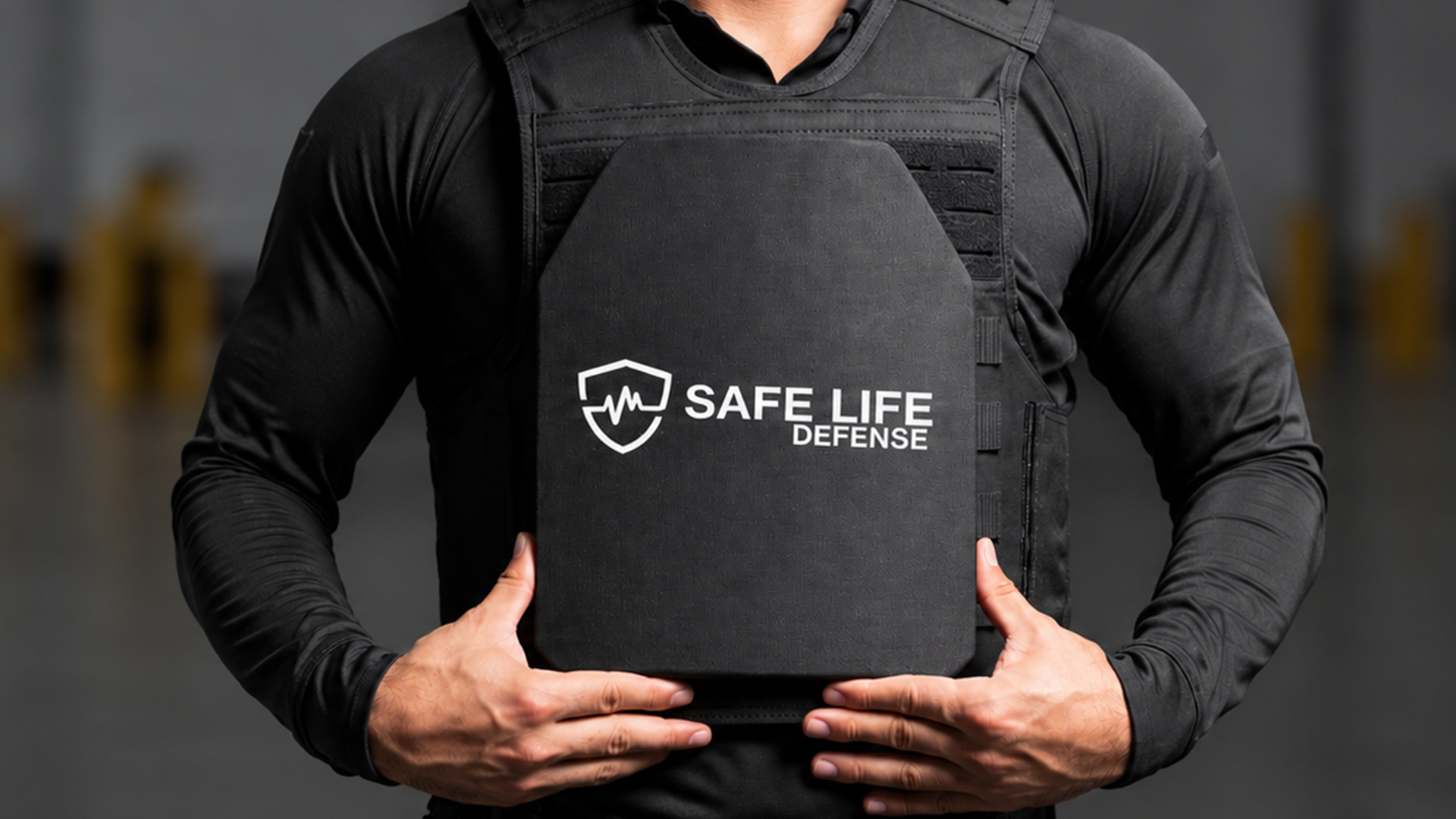
How a Properly Sized Plate Carrier Should Fit
Sizing is theory until you load the plates and put it on. The fit check is where you confirm the size is actually right.
One mechanical note that affects whether your fit holds over a long day: SLD panels are Self-Structured, meaning they free-float in the carrier and resist the sagging and curling that pull other setups out of position. The best fit in the world does not help if the armor slides down an hour into wear.
This guide gets you sized and verified. For the full walkthrough of donning the carrier and dialing in every strap, see how to wear body armor the proper way, and for building out the rest of the platform, setting up a plate carrier.
Most people are now sized and fitted. A few situations change the math. Here are the ones that matter.
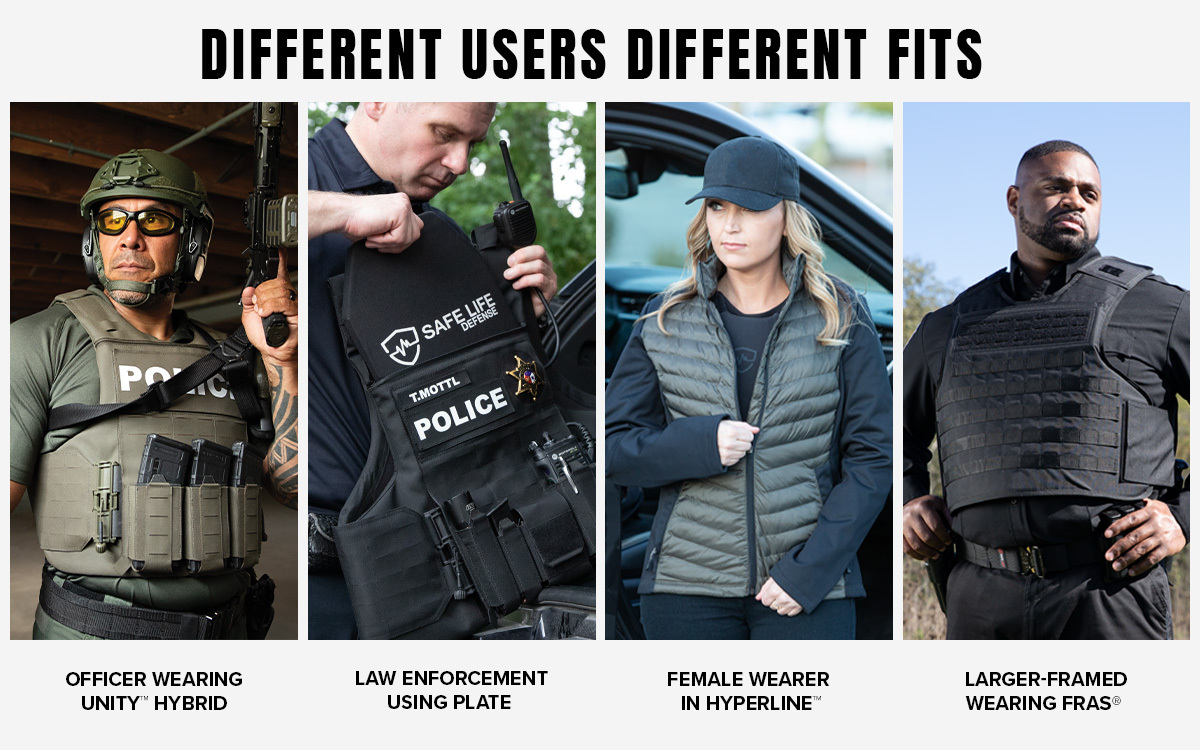
Special Cases That Change Your Size
The Two Sizing Models (and the Hybrid)
If the advice in this guide ever felt like it contradicted itself, this is why: there are two different sizing systems, and they only seem to conflict because people do not name them.
Neither are wrong. They are two systems for two kinds of armor. The reason this matters when you buy: a hybrid carrier can run soft panels (body-sized) or hard plates (plate-sized) in the same platform, sized by whichever armor you load into it. The Unity Hybrid system is built around exactly this, running soft panels, hard plates, and flexible rifle armor in one carrier, which is the cleanest example of both sizing models living under one roof.

Get It Right Once, and Wear It With Confidence
If you measured to the plate, matched the chart, and verified the fit with the plates loaded, you are sized correctly. That is the whole job.
Sizing armor from a screen is nerve-wracking, and it should be, given what it is for. That is why SLD offers a free Find My Size tool that works from your height and weight, and a Fit Guarantee with free size exchanges, so a close call does not mean living with the wrong size. Body armor only protects you if it fits and you actually wear it. Measure once, buy right, and put your attention where it belongs.
When you are ready, start with our carriers, plates, and the Unity Hybrid system.
This guide is general information on sizing and fit, not legal or medical advice. Always follow the fitting instructions for your specific armor, and for duty or professional use, follow your agency’s policy.

 Your Cart
 Product Protection from SLD